Bangkok Wakes to Rain
by Pitchaya Sudbanthad
At first, I tried to read Bangkok Wakes to Rain as a novel moving from one event to the next.
That was probably the wrong approach.
The book is fragmented. Lives appear, disappear and sometimes return much later, connected by places rather than by a single continuous story. It took me some time to stop waiting for the novel to settle into a more familiar shape.
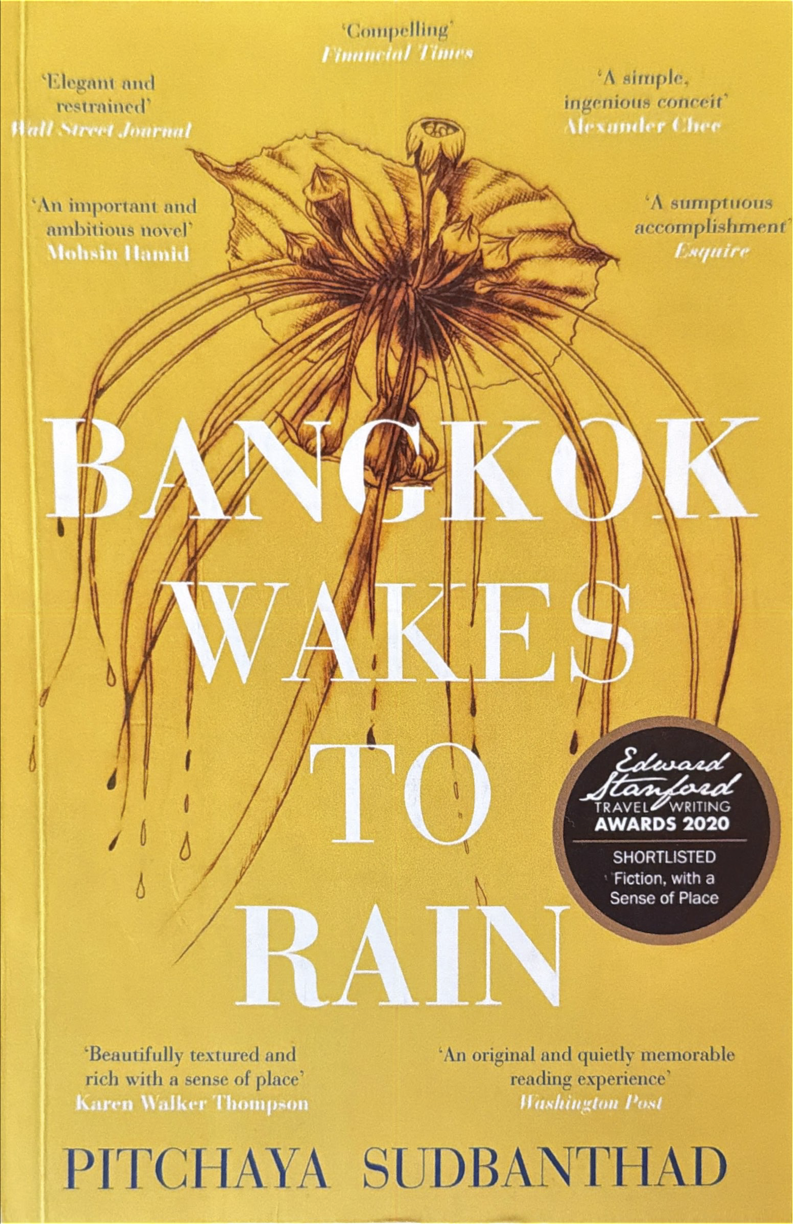
Cover of Bangkok Wakes to Rain by Pitchaya Sudbanthad.
And then there is rain.
Rain passes through different periods of the city and through the lives of the people who inhabit it. It falls on the same buildings long after their occupants have changed. Gradually, it becomes one of the things that makes these separate stories feel connected.
The house at the centre of the novel does something similar. People come and go, Bangkok changes around it, but traces of what happened there remain.
That was what stayed with me after reading: the sense of a city constantly changing while carrying pieces of what came before.
Sudbanthad moves between different periods of Bangkok and even imagines possible futures for it. At first this made the novel difficult for me to follow. Later, I began to see the fragmentation differently. A city is also made from lives that overlap without necessarily knowing one another, and from buildings that remain long after the people who knew them have gone.
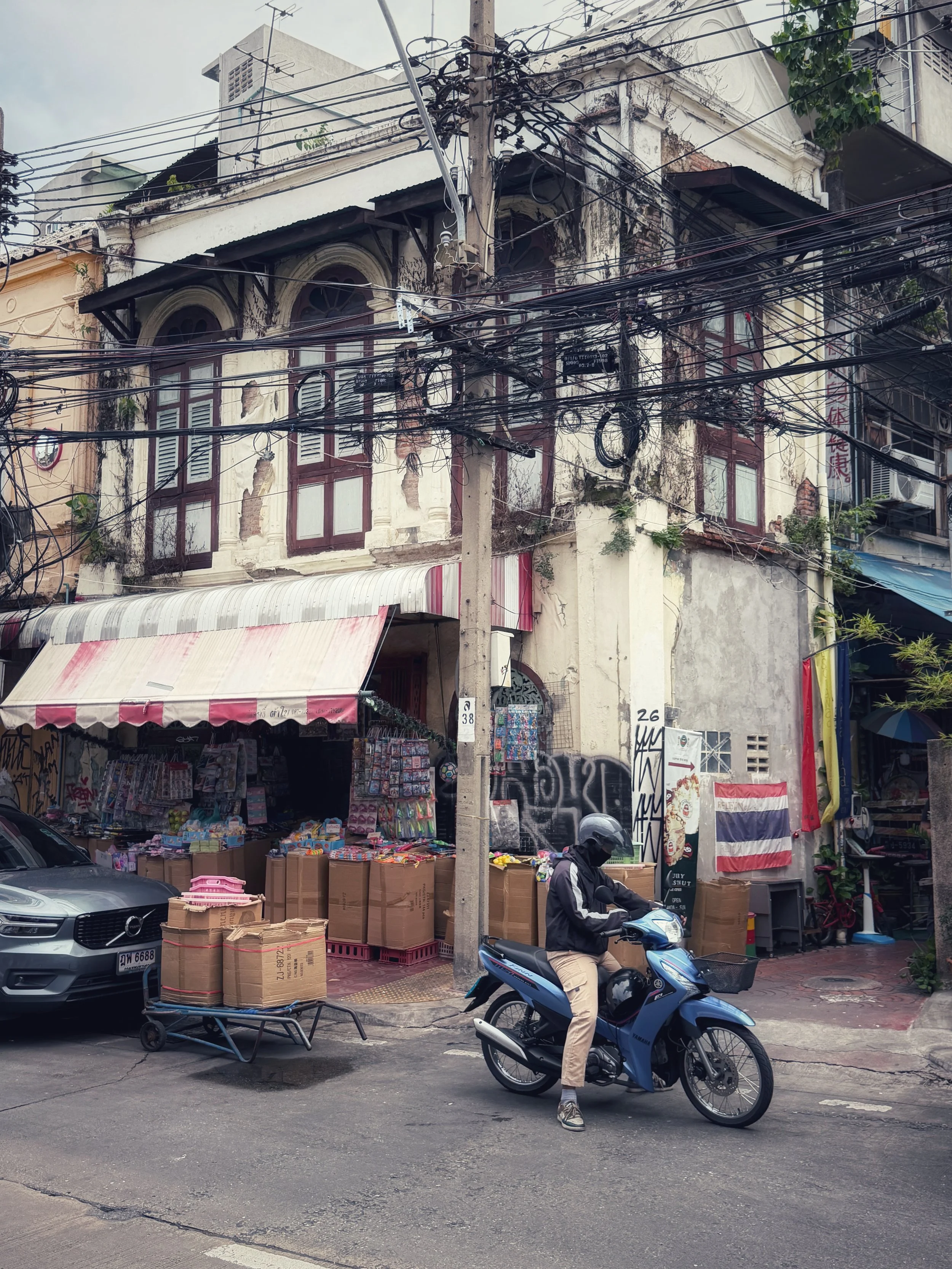
Old and new Bangkok sharing the same street.
That idea became much more tangible when I eventually reached Bangkok.
Older buildings survive between newer ones. Electrical cables cross façades that have already been altered many times. Shops occupy the ground floors while people pass on motorcycles or carry on with whatever the day requires. Nothing is preserved in isolation. Different periods simply continue beside one another.
The photograph above is one of the images that brought the novel back to me. I was drawn first to the ageing façade, but what interested me later was everything happening around it. The building had not become a monument to the past. Bangkok was still using it.
That felt very close to the city Sudbanthad had given me before I arrived.
Rain works in a similar way in the novel. It changes the appearance of the city without stopping it. Streets fill with water, surfaces become reflective, and familiar places suddenly look different.
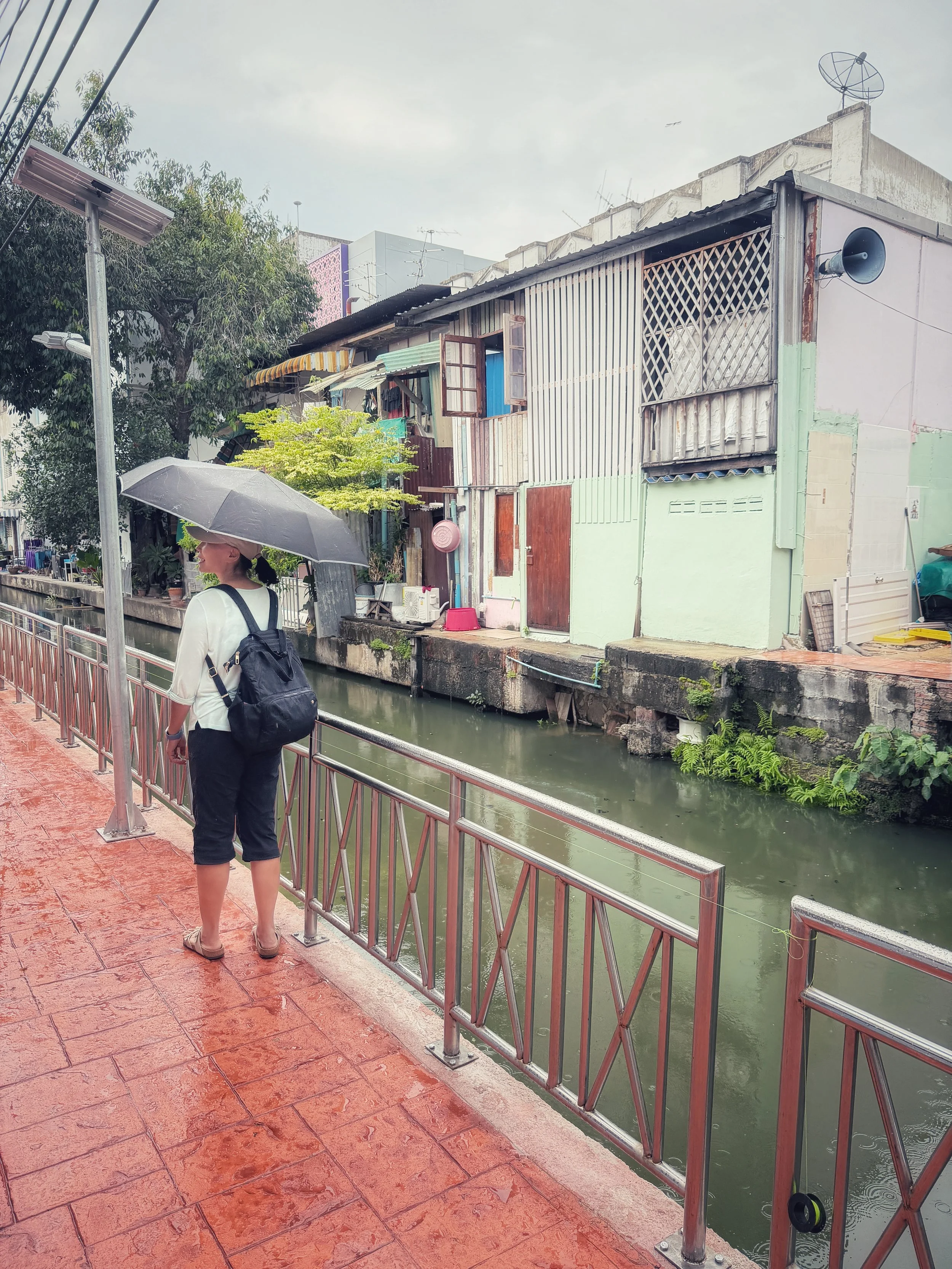
Bangkok after the rain.
I had known Bangkok through images long before I travelled there: temples, traffic, markets, neon lights. Bangkok Wakes to Rain made me curious about something less immediate — what remains after those first recognisable images have passed.
I became more attentive to buildings that seemed easy to overlook, to the river, and to the way rain could alter an ordinary street for a few minutes.
The novel also made me think differently about time. Bangkok changes quickly, but change does not necessarily remove what came before. An old house can survive beside a new tower. A street can acquire another use while still carrying traces of an earlier one. People inherit places without knowing everyone who lived there before them.
That is perhaps why the fragmented structure eventually began to make sense to me.
The lives in the novel do not need to form one continuous story. Their connection lies partly in the fact that they occupy the same city at different moments.
By the time I finished the book, Bangkok felt less like a place waiting to be discovered and more like somewhere I would only ever understand in fragments.
I read Bangkok Wakes to Rain before travelling there. When I eventually arrived, the novel did not give me a map of the city.
It gave me reasons to look twice.