J. M. Coetzee Disgrace
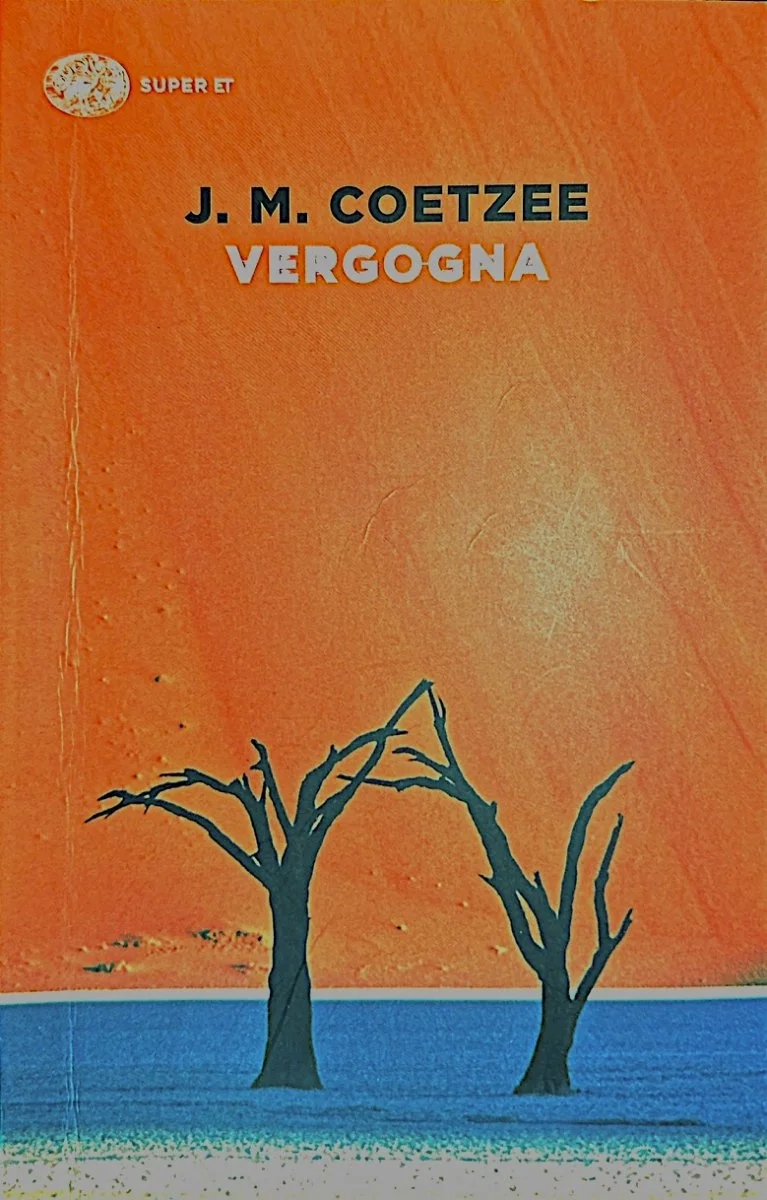
Book cover of J. M. Coetzee’s Disgrace (Italian edition, “Vergogna”).
Reading before travel
Synopsis
In post-apartheid Cape Town, Disgrace follows David Lurie, a university professor whose life unravels after a sexual relationship with a student. Refusing public remorse, he retreats to the rural Eastern Cape to live with his daughter Lucy, where his own disgrace becomes entangled with the country’s troubled past.
Disgrace – Listening to a Country Through Its Wounds
J. M. Coetzee’s
Disgrace is a difficult novel to keep reading, and I struggled with it at times.
I turned to this book while preparing for a journey to South Africa, a journey sparked by stories and by the kind of travel that begins with listening. Literature, for me, has always been a way to approach a place before setting foot on its soil: to understand something of its history and how that history is still present in everyday life.
David Lurie, a university professor in post-apartheid Cape Town, believes that his education and sophistication allow him to place his sexual desires under some kind of control, and that his position gives him, perhaps unconsciously, a certain right to act on them. His fall, following a sexual relationship with a student and his refusal to publicly express remorse, is swift. Coetzee strips the narrative of moral comfort. There is no easy condemnation, but neither does Lurie find redemption.
Lurie’s refusal
Lurie does not defend himself convincingly, nor does he truly repent. He refuses to confess in the way others expect him to, at a time when South Africa is still coming to terms with the moral consequences of apartheid. In that refusal, he appears increasingly out of place, a remnant of an older order that can no longer justify itself.
When he retreats to the Eastern Cape to live with his daughter Lucy, the novel’s focus subtly shifts. Questions of ownership and safety become more immediate, and the past feels much closer to the present.
Lucy
What stayed with me most was how central women are to the story and how often they are left to deal with the consequences.
Lucy keeps going, even when what happens to her becomes almost impossible to bear.
After the brutal attack, Lucy makes a choice that is difficult to understand. Her decision not to report the crime and not to leave the land is deeply unsettling. At first, I found Lucy’s choice difficult to accept. Yet within the world Coetzee portrays, it begins to make sense. She is trying to find a way to go on in circumstances she can no longer control.
Here, Disgrace begins to feel like an allegory. Or perhaps it simply started to read that way for me.
South Africa appears as a wounded woman, violated by history and left to deal with what remains. Throughout the novel, men often seem connected with power and possession, while women are tied more closely to the land and to what happens upon it. At least, that is how I came to read it.
The Eastern Cape
Coetzee’s prose is famously spare. The land is described without romanticism. Animals are euthanized. Dogs are burned.
Compassion appears in the way Lurie helps Bev Shaw at the animal clinic and cares for the dogs, even after death.
All carried out without much hope or ceremony.
Something changes in Lurie by the end of the novel.
He becomes less certain of himself and more willing to face suffering without trying to explain it away.
Why this book matters before traveling
Disgrace made me wary of easy conclusions about South Africa and its past.
It is a book about shame and about the way the past continues to affect the present. Coetzee offers no clear resolution, and perhaps that is what makes the novel so difficult to leave behind.
Reading it before traveling made me more aware of how much I did not understand about South Africa.
It made me want to arrive with fewer assumptions.
This is why this book belongs on RoamWithLens.
It reminded me that reading before a journey is not about finding answers. Sometimes it is simply a way of arriving with better questions.